
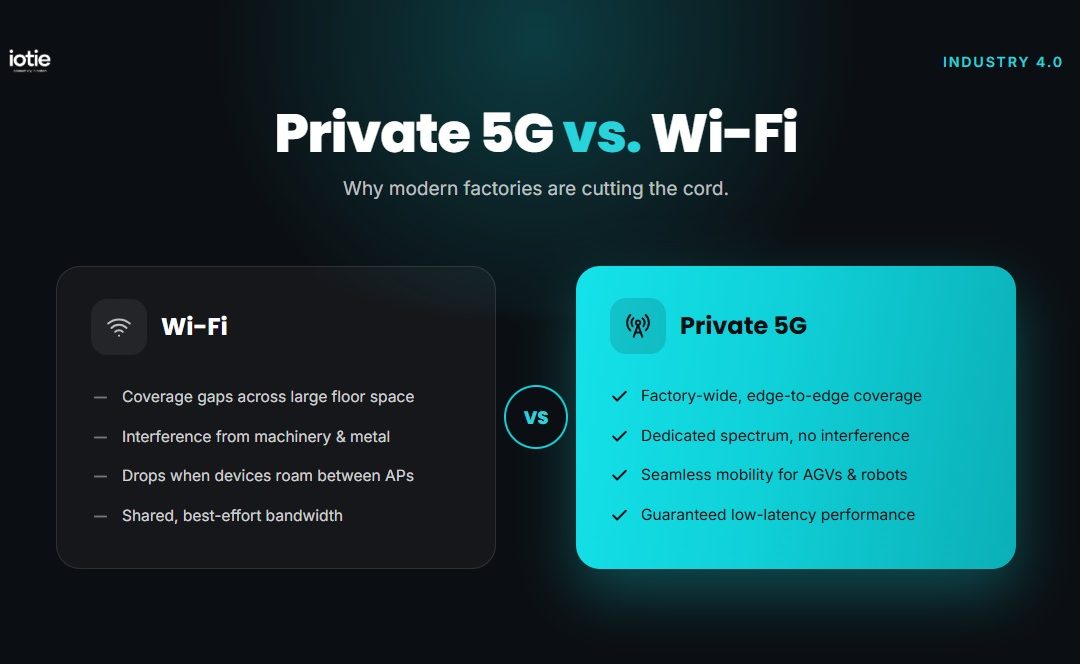
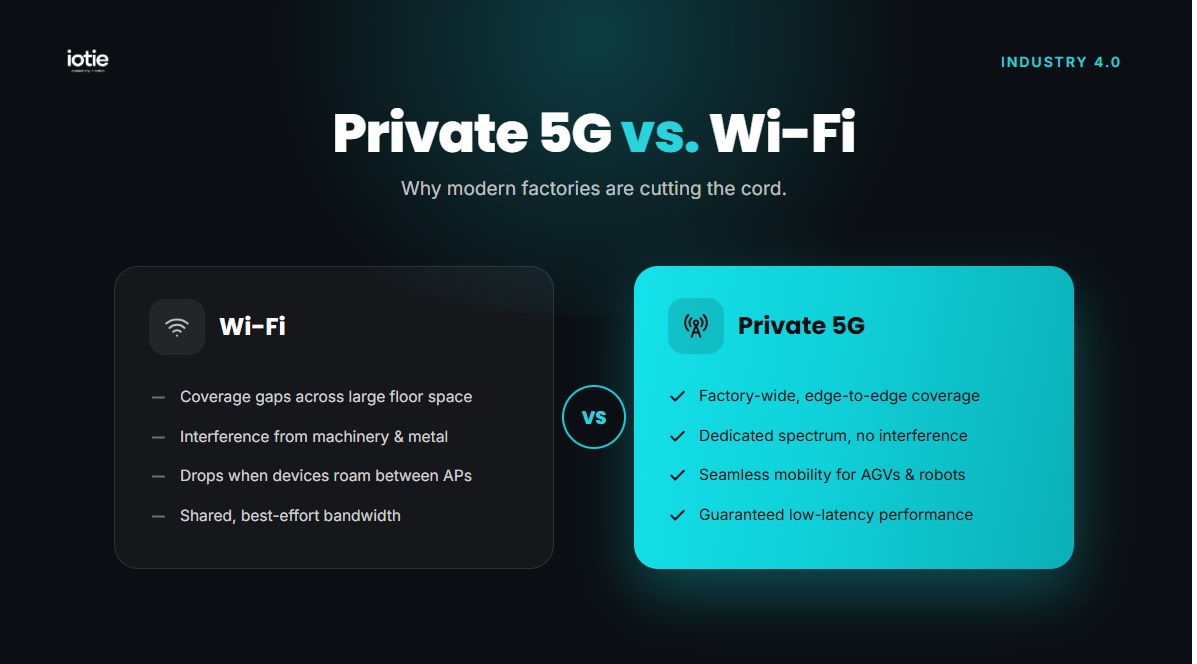
The modern factory floor is no longer a place of static assembly lines and manual clipboards. It has become a living, breathing organism of data, powered by the Industrial IoT. From robotic arms that adjust their grip in milliseconds to autonomous carts navigating busy aisles, the "Smart Factory" is a marvel of engineering. However, there is a silent bottleneck threatening this progress: the invisible threads of connectivity holding it all together.
For decades, Wi-Fi was the undisputed king of the enterprise. It was cheap, familiar, and "good enough." But as we push toward Industry 4.0, "good enough" is becoming a liability. We are witnessing a fundamental shift where industrial leaders are moving away from traditional wireless solutions as part of their digital transformation in favor of something more robust, more secure, and infinitely more capable. They are cutting the cord, and they are doing it with Private 5G.
The Great Industrial Disconnect: Why Wi-Fi is Falling Behind
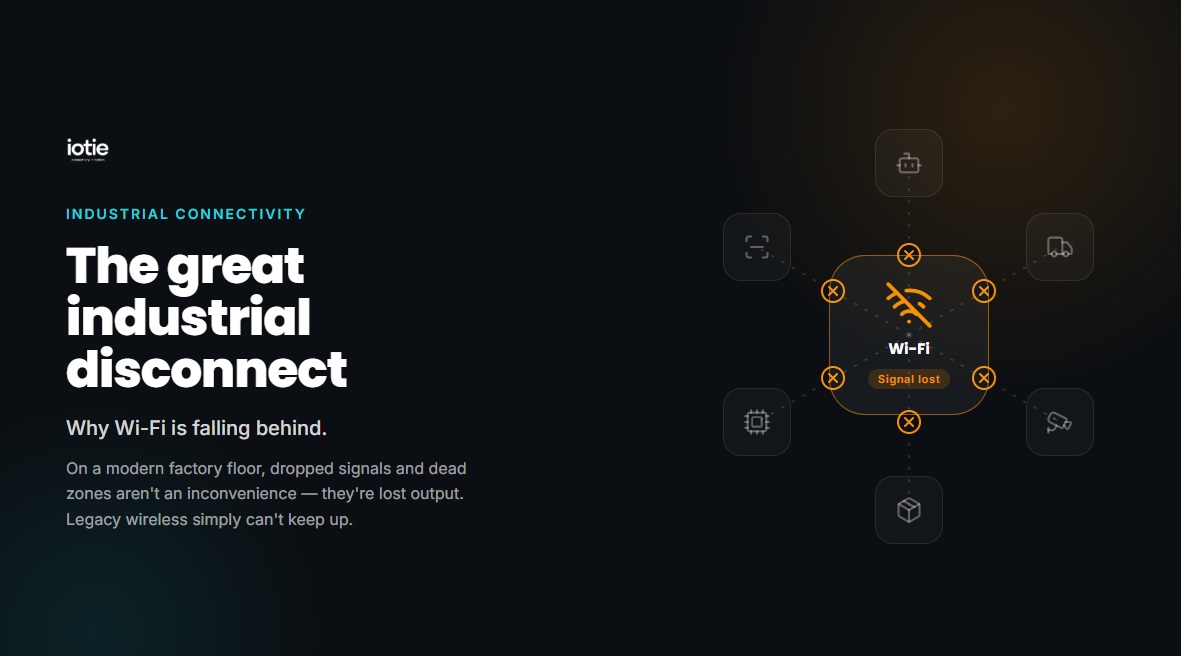
To understand why the industrial world is pivoting, we have to look at the inherent nature of Wi-Fi. Wi-Fi was originally designed for convenience and "best-effort" delivery. It excels at letting a group of people check emails in a coffee shop or stream a presentation in a conference room. It was never intended to manage a fleet of five-ton autonomous vehicles or maintain a sub-millisecond connection to a high-speed surgical robot in a healthcare setting.
The "Industrial Disconnect" happens when the demands of a high-tech facility outpace the physical capabilities of the network. When a connection drops for a split second in an office, a webpage takes an extra moment to load. When that same drop happens on a factory floor, a production line stops, a safety sensor fails to trigger, or a million-dollar piece of equipment sits idle. The stakes are simply higher, and Wi-Fi is starting to show its age under the pressure.
The Limitations of Wi-Fi in High-Stakes Environments
Wi-Fi operates on shared, unlicensed spectrum. This means it is fighting for airtime with every other device in the vicinity, from the microwave in the breakroom to the smartphone in a visitor's pocket. In a controlled industrial setting, this lack of exclusivity creates three primary headaches.
The "Shadow Corner" Problem: Coverage and Interference
If you’ve ever walked through a warehouse and lost your signal behind a stack of metal crates, you’ve experienced the "Shadow Corner." Wi-Fi signals, particularly the high-frequency bands used in newer standards, struggle to penetrate dense materials. Industrial environments are filled with steel, concrete, and heavy machinery—all of which act as mirrors or shields for Wi-Fi waves. To cover a massive plant, you often need hundreds of access points, each creating a potential point of failure and a complex web of interference.
Latency and the Handover Lag
Think of Wi-Fi like a series of small islands. As a mobile robot moves across the factory, it has to "jump" from one island (access point) to the next. This process, known as a handover, is notoriously clunky in Wi-Fi networks. There is a brief moment of hesitation—a spike in latency—where the device is disconnected from the old point before it shakes hands with the new one. In the world of high-speed automation, that 100-millisecond lag is an eternity. It leads to jerky movements, communication errors, and a complete inability to run truly real-time applications.
The Shared Spectrum Security Risk
Because Wi-Fi operates on open frequencies, it is inherently more vulnerable. Anyone with a basic receiver can detect the presence of the network. While encryption has improved, the "open door" nature of unlicensed spectrum makes it easier for bad actors to jam signals or attempt de-authentication attacks. For a facility managing proprietary manufacturing processes, critical utilities, or sensitive intellectual property, relying on a signal that can be easily interfered with from the parking lot is a significant business risk.
What Exactly is Private 5G?
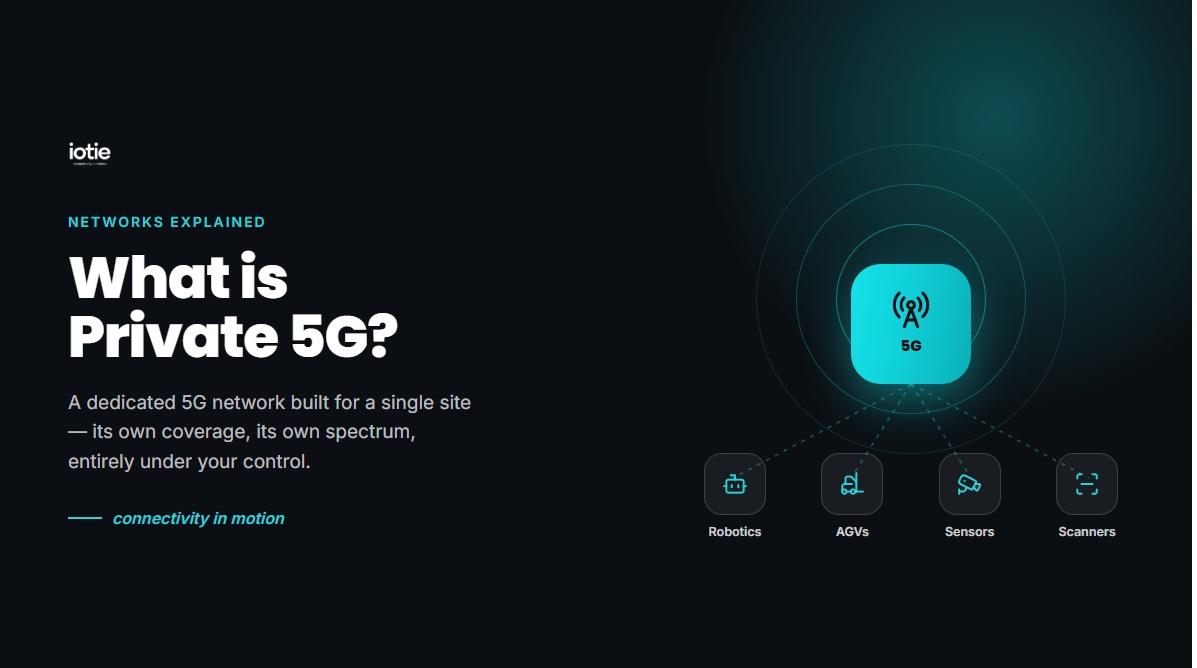
If Wi-Fi is a public park where anyone can walk their dog, Private 5G is a gated estate with a private security detail. It is a dedicated cellular network built specifically for a single organization’s use, utilizing the same technology that powers national mobile networks and smart cities but localized to a specific campus or facility.
Your Own Personal Cellular Island
A Private 5G network provides you with your own "slice" of the airwaves. You aren't sharing the signal with the public or the neighboring business. You own the infrastructure—the small cells, the core network, and the SIM cards. This gives you total control over who connects, how the data is routed, and the scalability to adjust how much bandwidth is allocated to specific tasks. It is a closed loop, offering the reliability of a wired connection with the freedom of wireless.
The Marriage of Edge Computing and Connectivity
One of the most powerful aspects of Private 5G is how it integrates with Edge Computing. Instead of sending data to a distant cloud server and waiting for a response, Private 5G allows you to process data right there on the factory floor. The network acts as the nervous system, while the Edge servers act as the local brain. This combination allows for "ultra-reliable low-latency communication" (URLLC), providing the ultra-low latency that enables machines to react to data faster than a human can blink.
Reliability and Predictability: The Core Drivers of Migration
The move to Private 5G isn't just about speed; it's about certainty. In an industrial setting, knowing exactly how your network will behave at 2:00 PM on a Tuesday is more valuable than having high peak data rates that fluctuate.
Slicing the Network: Prioritising Critical Operations
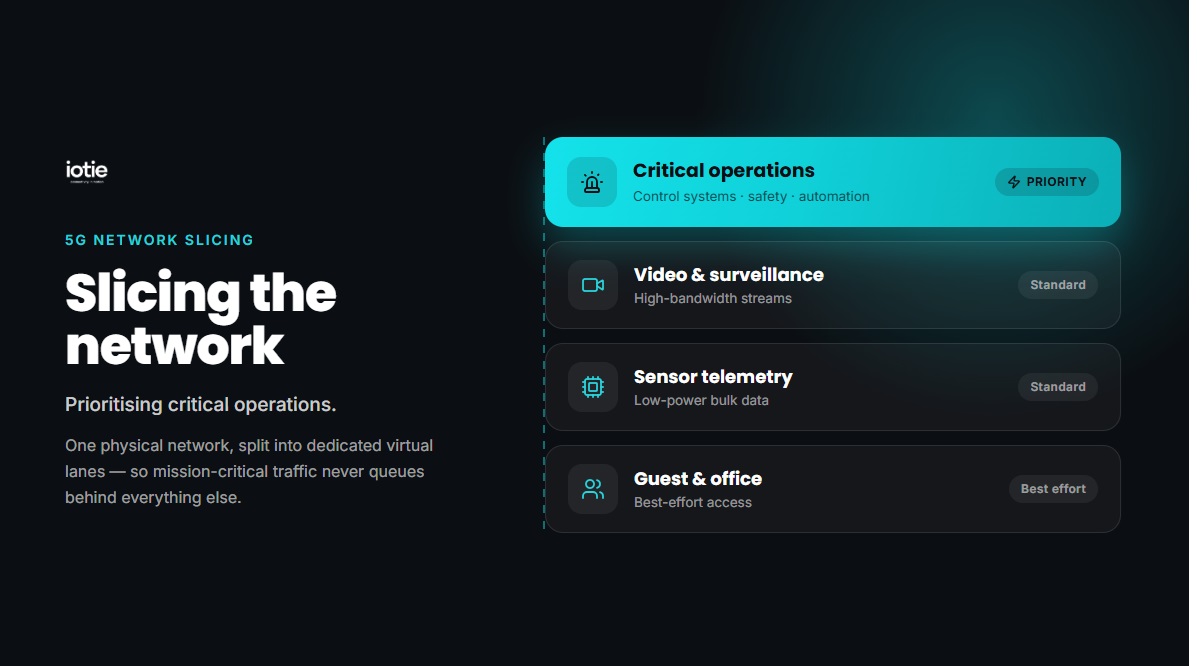
Imagine you have a single pipe of data entering your factory. With Wi-Fi, everything—the security cameras, the guest tablets, and the emergency shut-off sensors—competes for space in that pipe. Private 5G introduces "Network Slicing." You can virtually carve that pipe into dedicated lanes. You can create a "Gold Lane" for mission-critical safety systems that is guaranteed 100% uptime, a "Silver Lane" for autonomous robots, and a "Bronze Lane" for general administrative traffic. No matter how busy the office staff gets downloading files, they can never crowd out the robots on the floor.
Massive Machine-Type Communications (mMTC)
A single 5G cell can support up to a million devices per square kilometer. This is the foundation of "Massive Machine-Type Communications." In a modern factory, every pallet, every tool, and every motor might have a sensor attached to it, expanding the reach of the Internet of Things and the number of connected IoT devices. Wi-Fi networks quickly choke when asked to manage thousands of simultaneous connections. Private 5G handles this density with ease, allowing for a truly granular view of the entire operation without the risk of network congestion.
Real-World Transformations: Private 5G in Action
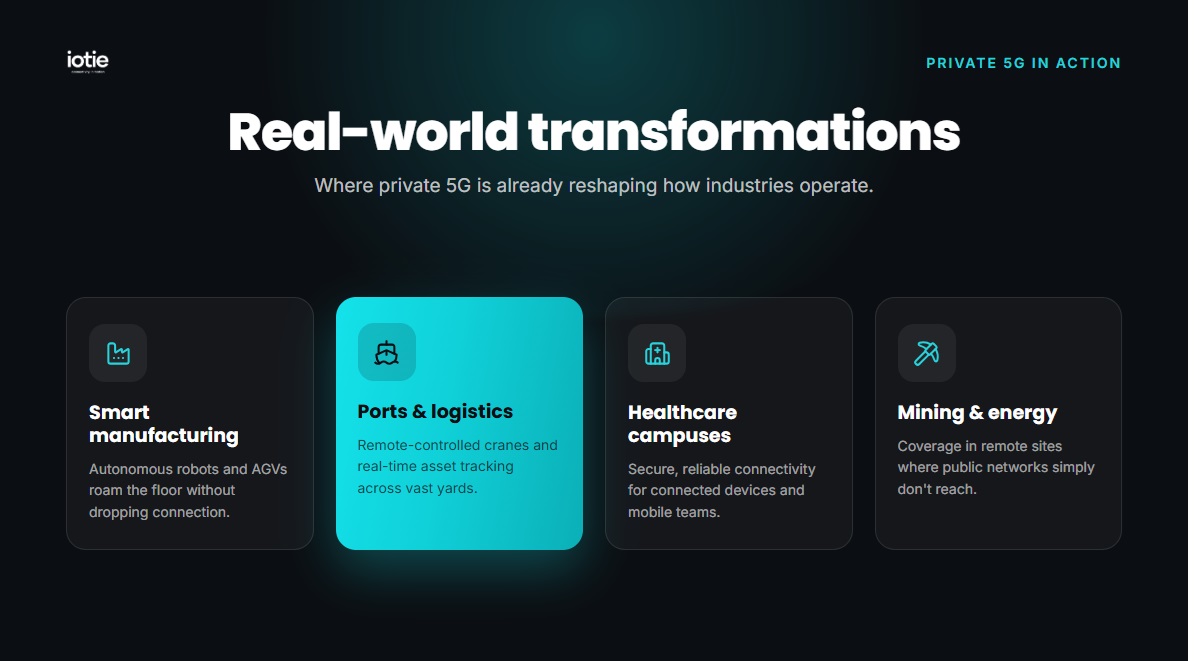
To see the value of Private 5G, we have to look past the spec sheets and onto the floor.
Unleashing Autonomous Mobile Robots (AMRs)
In a Wi-Fi-led warehouse, AMRs and AGVs, or automated guided vehicles, often have to move slowly or follow rigid paths to avoid losing their connection. With Private 5G, these robots gain "seamless roaming." They can zip across vast distances, weaving through metal shelving, without ever losing a packet of data. This allows for more dynamic pathfinding and higher speeds, which directly translates to increased throughput and efficiency.
Augmented Reality (AR) for Real-Time Maintenance
Imagine a technician wearing an AR headset while performing predictive maintenance on a complex turbine. The headset overlays 3D schematics directly onto the machine and streams a high-definition video feed to an expert halfway across the world for guidance. This requires massive upload bandwidth and near-zero latency. Private 5G provides the stable "pipe" necessary to make industrial AR a daily reality, reducing repair times and eliminating the need for expensive travel.
Precision Asset Tracking Across Miles of Floor Space
In massive shipyards or sprawling automotive plants, finding a specific engine block or shipping container can be like finding a needle in a haystack. Because Private 5G provides consistent coverage even in outdoor areas and through dense obstacles, it enables high-precision tracking. Managers can see the real-time location of every asset within inches, streamlining logistics and reducing the "hidden costs" of lost inventory.
Security and Data Sovereignty
For many enterprises, the strongest argument for Private 5G is the peace of mind it provides. In an era of increasing cyber threats, the physical and digital isolation of a private cellular network is a powerful deterrent.
SIM-Based Authentication vs. Passwords
Wi-Fi security usually relies on passwords or digital certificates, which can be stolen, shared, or spoofed. Private 5G uses SIM-based authentication—the same hardware-level security used by global banks and governments. To get on the network, a device must have a physical or electronic SIM card provisioned by the company. This makes unauthorized access nearly impossible for outside devices.
Keeping Data Inside the Four Walls
When you use a public network or certain cloud-based Wi-Fi network management systems, your data often travels through the public internet before it reaches its destination. With a Private 5G network, your data never has to leave your facility. The "Core" of the network sits in your server room. This "Data Sovereignty" is vital for industries with strict regulatory requirements or those who want to ensure their proprietary manufacturing data is never exposed to the outside world.
The Complexity of Implementation: Is It Right for You?
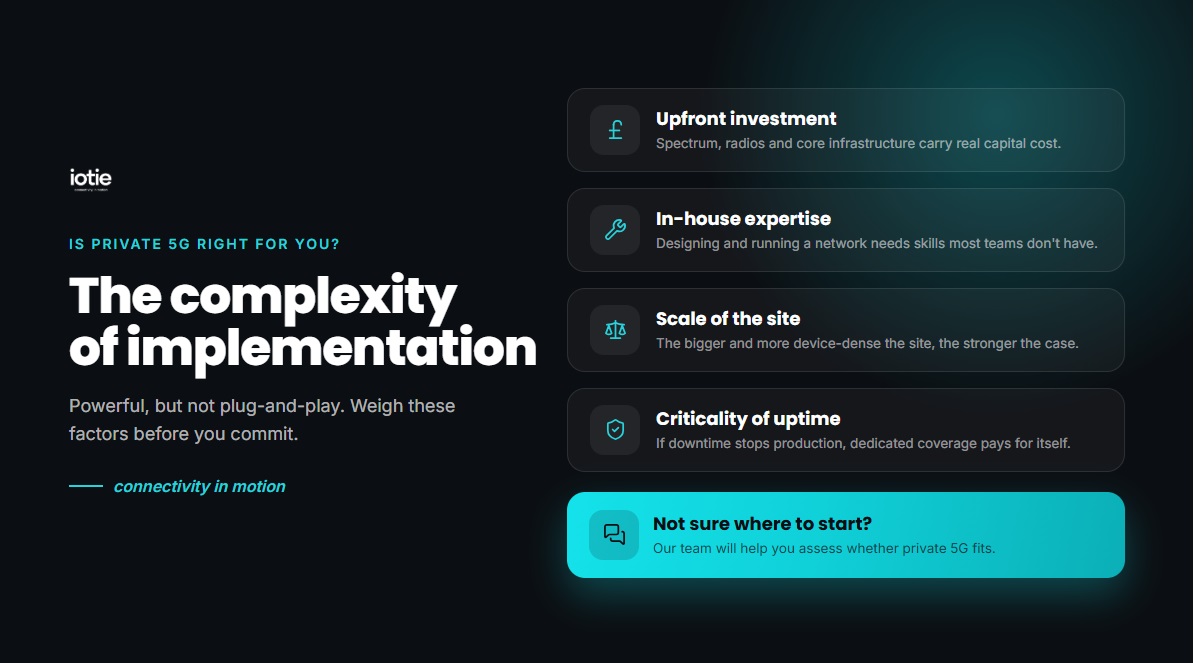
While the benefits are clear, Private 5G is not a "plug-and-play" solution like a home router. It is a sophisticated piece of infrastructure that requires careful planning.
Spectrum Acquisition: Licensed vs. Unlicensed
To run a Private 5G network, you need access to the airwaves. In some countries, governments have set aside specific "industrial" bands (like CBRS in the United States) that companies can use for free or a small fee. In other regions, you may need to lease spectrum from a traditional mobile carrier. Navigating these regulatory waters is the first hurdle in any deployment.
The Initial Investment and Long-Term ROI
There is no sugarcoating it: Private 5G is more expensive upfront than Wi-Fi. You are buying enterprise-grade radio units and base stations, a core network server, and often paying for specialized integration services. However, the ROI isn't found in the hardware cost; it’s found in the elimination of downtime, the increase in worker productivity, and the ability to automate processes that were previously impossible. For a large-scale operation, the cost of a single major Wi-Fi outage can often exceed the entire setup cost of a 5G network.
Management and Maintenance: Specialised Skillsets
Managing a cellular network is different from managing an IT network. It requires knowledge of radio frequency (RF) engineering and cellular protocols. While many vendors now offer "Network as a Service" (NaaS) models where they manage the complexity for you, it is still a significant shift in how an organization thinks about its internal connectivity.
The Hybrid Future: When to Use Both
It is important to note that Private 5G isn't a "Wi-Fi Killer"—it's a Wi-Fi successor for specific use cases. The future of the enterprise is likely hybrid.
When Wi-Fi Still Makes Sense
Wi-Fi 6 and 6E are incredible technologies. For office spaces, guest access, or non-critical tasks like printing or basic web browsing, Wi-Fi remains the most cost-effective and logical choice. There is no need to put a 5G SIM card in every office printer.
Building a Cohesive Enterprise Ecosystem
The goal for most companies should be a seamless integration. The office runs on Wi-Fi 6, the factory floor runs on Private 5G, and the two networks communicate through a secure gateway. This "best of both worlds" approach ensures that resources are allocated where they provide the most value, creating a cohesive ecosystem that supports both humans and machines.
Final Thoughts: Moving Toward the Autonomous Factory
The transition from Wi-Fi to Private 5G represents more than just a hardware upgrade; it represents a commitment to the future of automation. As we move toward factories that can self-correct, self-optimize, and operate with minimal human intervention, the "nervous system" of the facility must be flawless.
Private 5G provides the reliability, security, and low latency required to turn the dream of the fully autonomous factory into a reality. For companies looking to lead their industry in the next decade, the question is no longer if they should move toward private cellular, but how fast they can get there.
FAQs About Private 5G for Industry
How much does it cost to deploy Private 5G compared to Wi-Fi 6?
On average, a Private 5G deployment can be 2 to 3 times more expensive than a high-end Wi-Fi 6 setup in terms of initial capital expenditure. However, because 5G cells have a much larger range, you often need significantly fewer units to cover the same area, which can offset some of the costs in large-scale environments.
Do I need to be a telecom expert to manage a private network?
While the technology is complex, the market has shifted toward "as-a-service" models. Most major equipment vendors and system integrators now offer managed services where they handle the technical "heavy lifting," allowing your internal IT team to manage the network through a user-friendly dashboard similar to what they use for Wi-Fi.
Is Private 5G safe for human workers in close proximity?
Yes. Private 5G operates within the same safety standards and power limits as public cellular networks and Wi-Fi. The "small cells" used in factories are low-power devices designed to be safe for continuous human presence, following strict international guidelines on electromagnetic field (EMF) exposure.