
Private 5G Networks Explained: Why Businesses are Moving Away from Public Airwaves
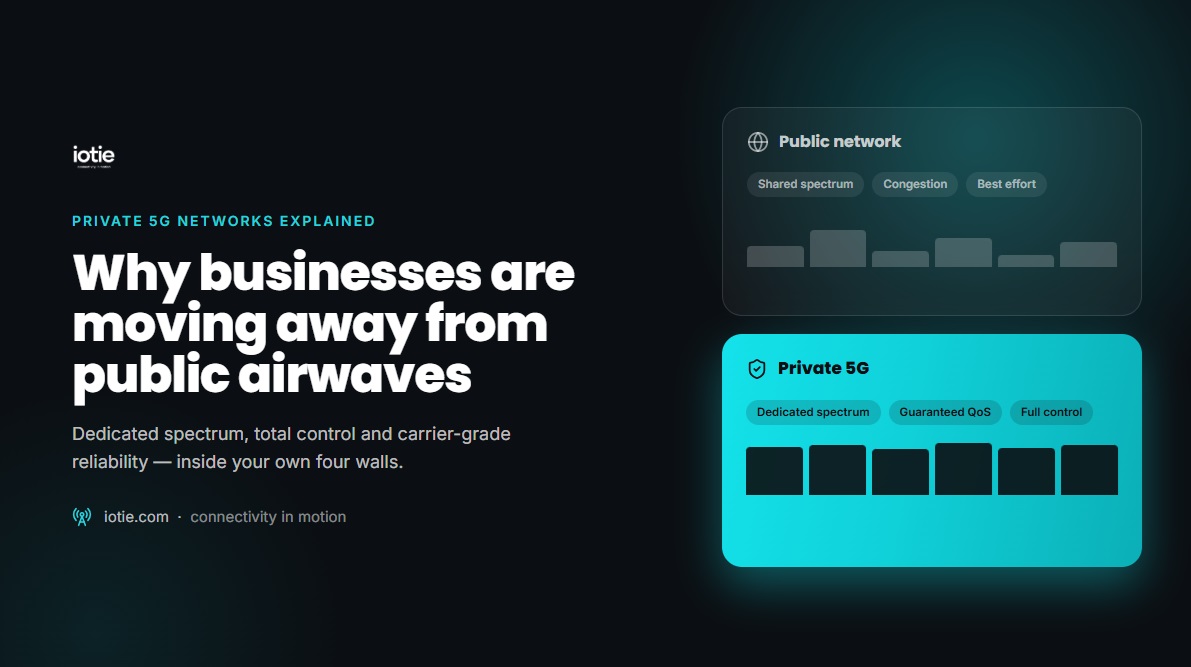
What is private 5g? In the early days of the internet, a simple Ethernet cable or a shaky Wi-Fi router was enough to keep a business running. But today, we are asking our networks to do the impossible. We are asking them to coordinate thousands of autonomous robots in a warehouse, transmit high-definition surgical video and augmented reality overlays in real-time, and manage millions of data points from industrial sensors—all without a single millisecond of lag.
Standard public networks are buckle-streaking under this pressure. This is why a quiet revolution is happening inside factories, mines, hospitals, and even emerging smart cities. Enterprises are no longer waiting for telecom giants to provide the perfect connection; they are building their own. Private 5G isn't just a faster version of private LTE or the internet you have on your phone; it is a fundamental shift in how organisations own, control, and deploy their digital nervous systems.
The Connectivity Revolution: Why Private 5G is More Than Just a Buzzword
You’ve likely seen the commercials for 5G—lightning-fast downloads and seamless streaming on the go. While that’s great for consumers, for a business, "fast" isn't enough. A business needs "guaranteed." When a remote-controlled crane is lifting a multi-ton shipping container, it doesn't matter if the average speed of the network is high; it matters that the connection doesn't drop for even a fraction of a second.
Private 5G has moved past the hype cycle because it solves the "best-effort" problem of traditional wireless. Public networks are designed to serve as many people as possible reasonably well. Private 5G is designed to serve one organisation perfectly. This revolution is about moving from shared, unpredictable airwaves to a dedicated, high-performance infrastructure that functions more like a private utility than a public service.
Understanding the Basics: What Exactly is a Private 5G Network?
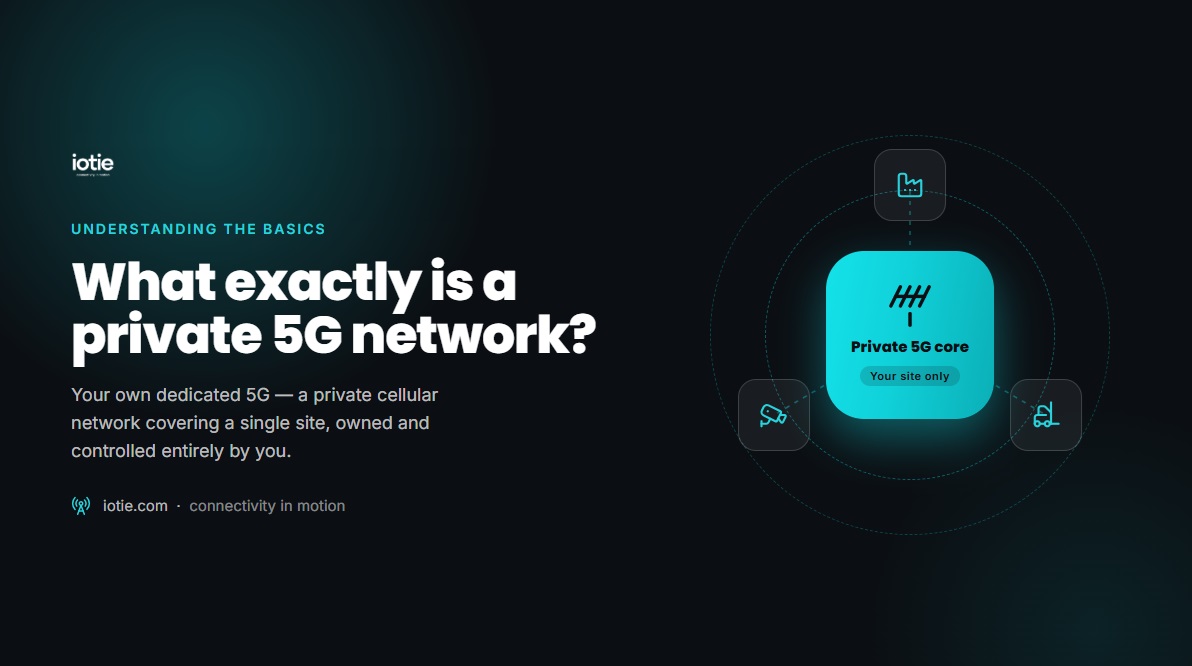
At its simplest, a private 5G network is a local area network (LAN) that uses 5G technology to create a dedicated communication system within a specific geographic area, such as a manufacturing plant or a corporate campus. It provides all the technical advantages of 5G—high speed, low latency, and massive capacity—but limits access to authorised users within that specific organisation.
Think of it like the difference between using a public highway and owning a private test track. On the public highway, you are at the mercy of traffic, construction, and the driving habits of others. On your private track, you set the speed limits, you decide who gets a lane, and you ensure the pavement is always pristine.
The Core Components of a Private Infrastructure
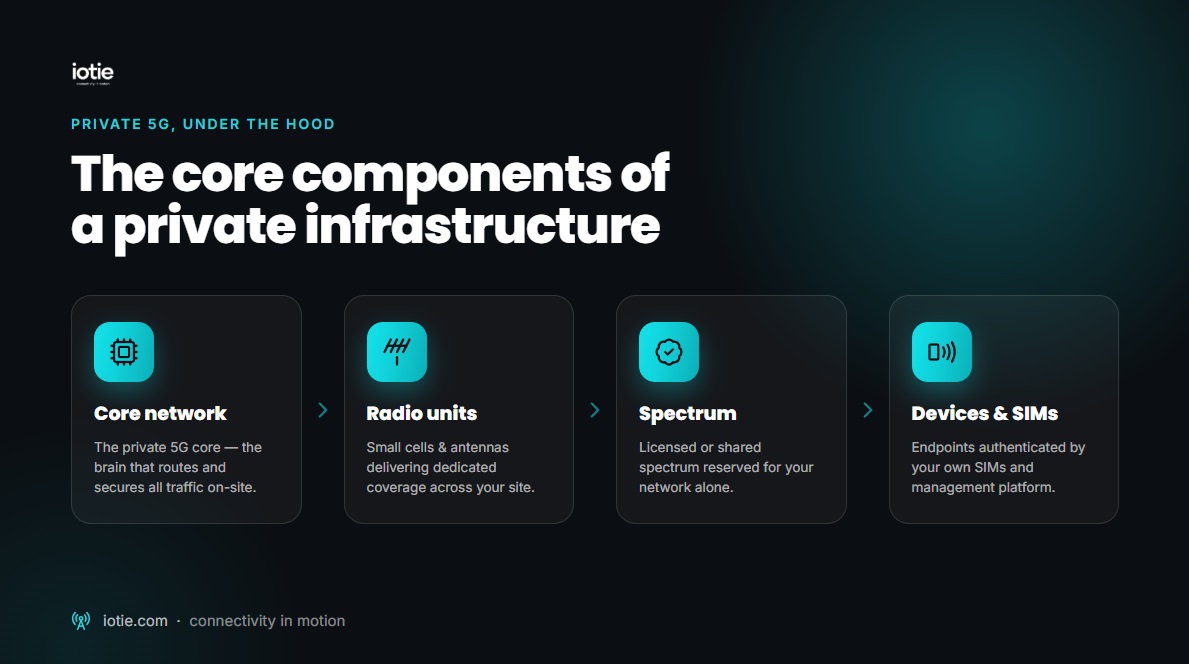
To build this "private track," an organisation needs three main ingredients. First is the Core Network, which acts as the brain, managing user authentication and routing data. Second are the Radio Access Network (RAN) components, consisting of base stations, small cells, and antennas that blanket the site in a 5G signal. Finally, there are the Devices—the sensors, vehicles, and tablets acting as IoT devices equipped with 5G-compatible SIM cards. Unlike a public network where the "brain" might be hundreds of miles away in a carrier’s data center, in a private setup, these components are often physically located on the company's premises.
How it Differs from the 5G on Your Smartphone
When you use 5G on your smartphone, you are a guest on a network managed by a provider like Verizon, AT&T, or Vodafone. You share bandwidth with every other person in your post code. If a thousand people nearby start streaming video at once, your performance might dip.
In a private 5G network, you are the owner, not the guest. There is no "outside" traffic. The network is tuned specifically for your devices. Furthermore, while your phone uses a public SIM card, a private 5G network uses proprietary SIMs or digital credentials. This means a random person walking past your factory can’t even see your network, let alone join it.
The "Public Airwave" Problem: Why Wi-Fi and Public 5G Often Fall Short
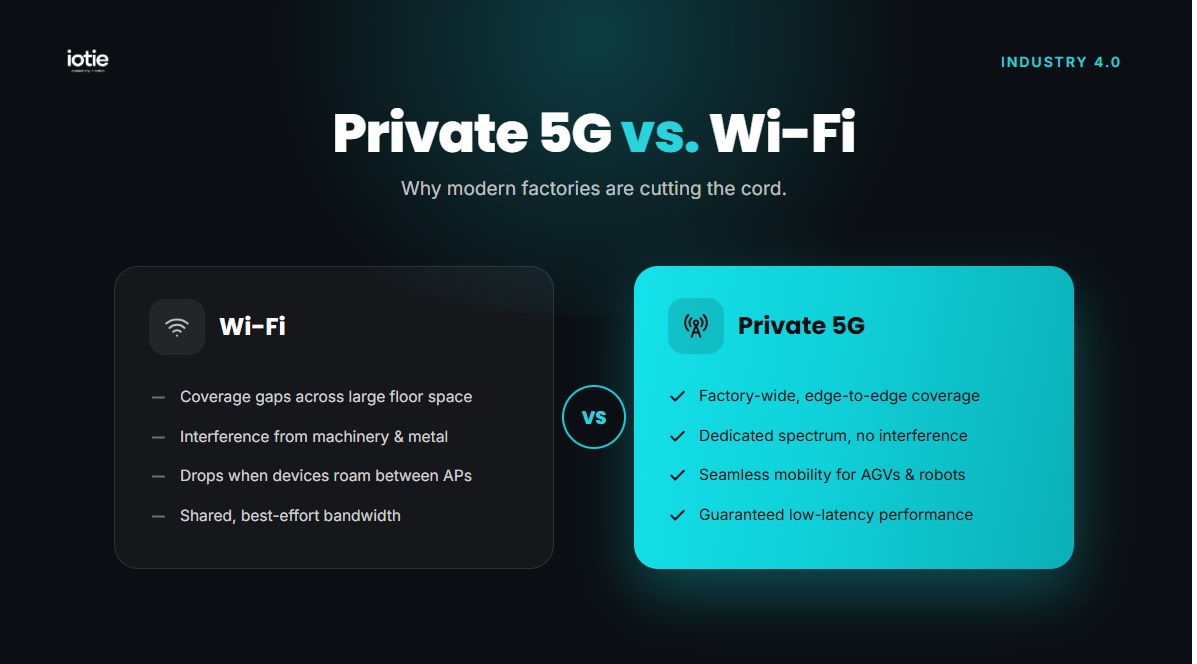
For years, Wi-Fi has been the go-to for indoor connectivity. It’s cheap and familiar. However, as we move into the era of Industry 4.0, Wi-Fi is showing its age. Wi-Fi was designed for "stationary" connectivity—sitting at a desk with a laptop. It struggles with "handover," which is the process of a moving device switching from one access point to another. In a fast-moving automated warehouse, that split-second handoff failure can cause a robot to grind to a halt. See our blog on Private 5G v WiFi.
The Crowded Room Analogy: Dealing with Interference
Imagine trying to have a deep, technical conversation in a crowded, noisy restaurant. That is Wi-Fi in an industrial setting. Wi-Fi operates on "unlicensed" spectrum, meaning anyone can use it. Your neighbor’s router, the microwave in the breakroom, and even Bluetooth devices all scream over the same frequencies. This leads to interference and "jitter." Private 5G, by contrast, operates on "licensed," "priority," or even shared spectrum models. It’s like being in a soundproofed boardroom; the only voices are the ones you’ve invited, and they never have to shout to be heard
The Latency Gap: Why Microseconds Matter in Industry
In the consumer world, latency (the delay between sending and receiving data) is the difference between a video starting instantly or buffering for a second. In the industrial world, latency is a safety and precision issue. If a sensor detects a human hand too close to a robotic press, that "stop" command needs to travel instantly. Public 5G, while fast, still routes data through various external exchanges, adding "hops" that increase latency. Private 5G keeps the data processing local, reducing latency to single-digit milliseconds—fast enough for the most sensitive haptic feedback and real-time control loops.
The Architecture of Privacy: How Private 5G Works
The magic of private 5G lies in its network architecture and total sovereignty. It is built from the ground up to be isolated, which allows for levels of customisation that public providers simply cannot offer.
Dedicated Spectrum: Your Own Lane on the Information Highway
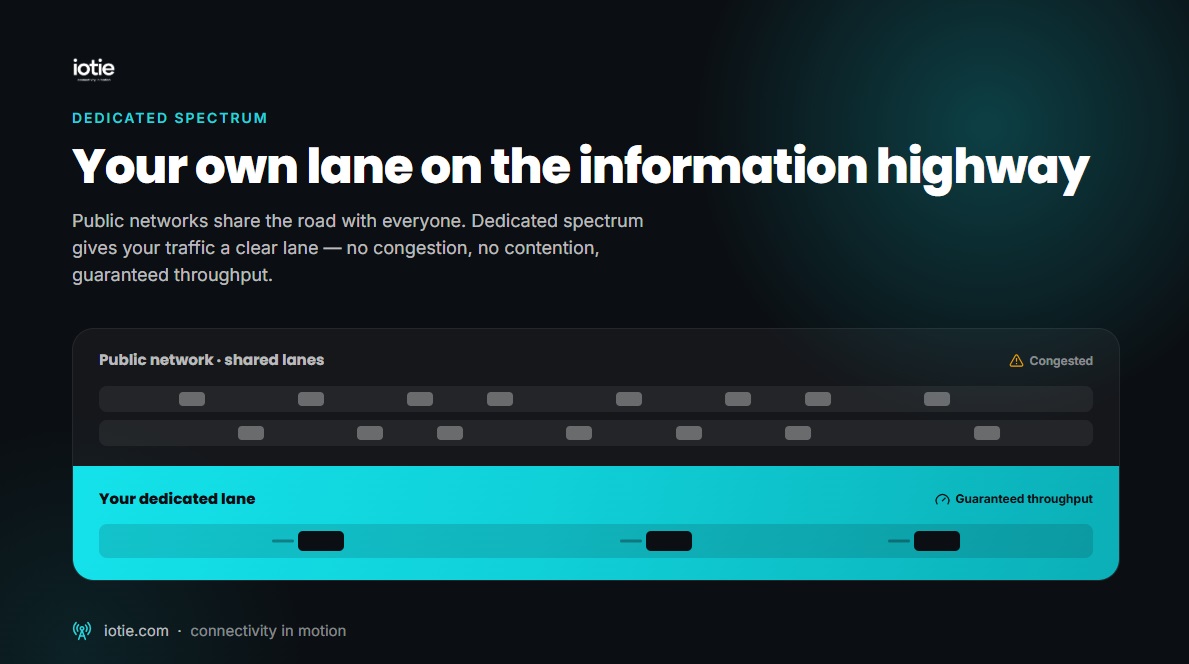
Spectrum is the invisible "soil" in which wireless signals grow. Traditionally, only giant telcos could own spectrum. However, regulators worldwide (like the FCC in the US with Citizens Broadband Radio Service and Ofcom in the UK with the shared access spectrum licence) have begun carving out slices of spectrum specifically for private enterprise use. This dedicated spectrum ensures that your data isn't competing with a teenager’s TikTok upload three blocks away. It is your exclusive lane, and it stays clear 24/7.
On-Site Hardware: Keeping Data Within the Four Walls
In a typical public 5G setup, your data travels from your device to a cell tower, then through the public internet to a cloud server, and back again. With private 5G, the "Edge" is right there in your facility, enabling powerful edge computing capabilities. The servers that process your data sit in your own server room. This creates a "walled garden" where sensitive intellectual property—like proprietary manufacturing algorithms—never actually leaves the physical premises.
Network Slicing: Tailoring Performance for Specific Tasks
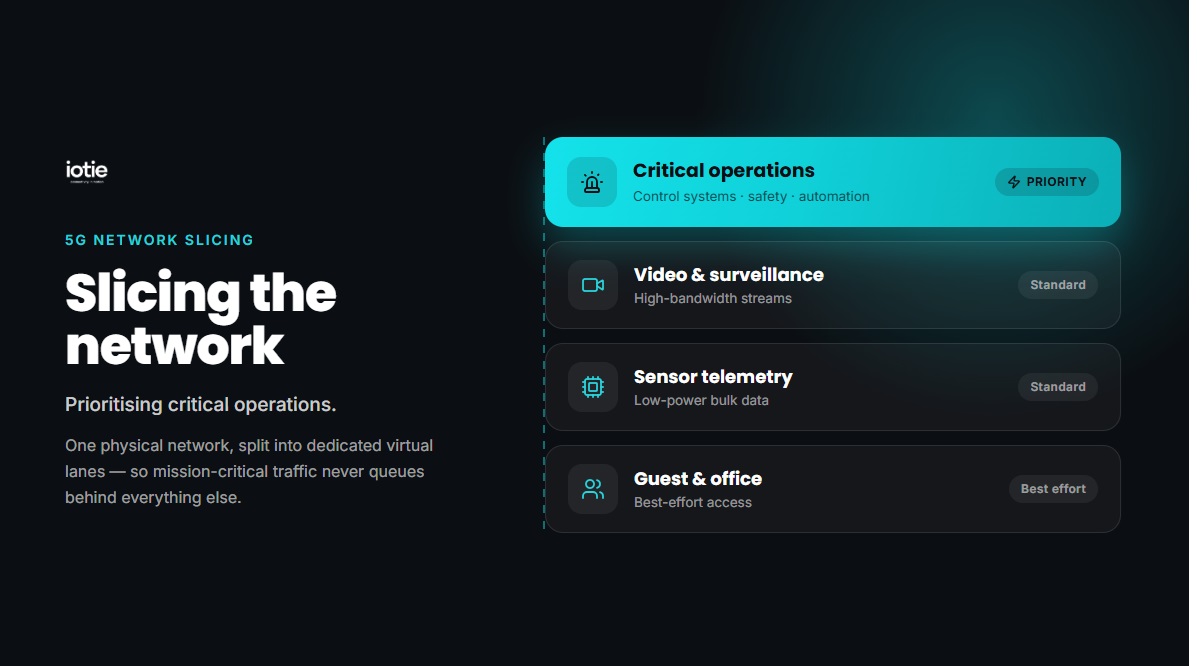
One of 5G's most powerful features is "Network Slicing." Think of this as creating multiple virtual networks on the same physical hardware. You can create one "slice" that is optimised for ultra-low latency for your robotics, another "slice" with massive bandwidth for high-def security cameras, and a third "slice" for basic administrative tablets. Each slice is isolated, so a surge in camera traffic won't ever slow down the robots.
The Power of Control: Key Benefits Driving Business Adoption
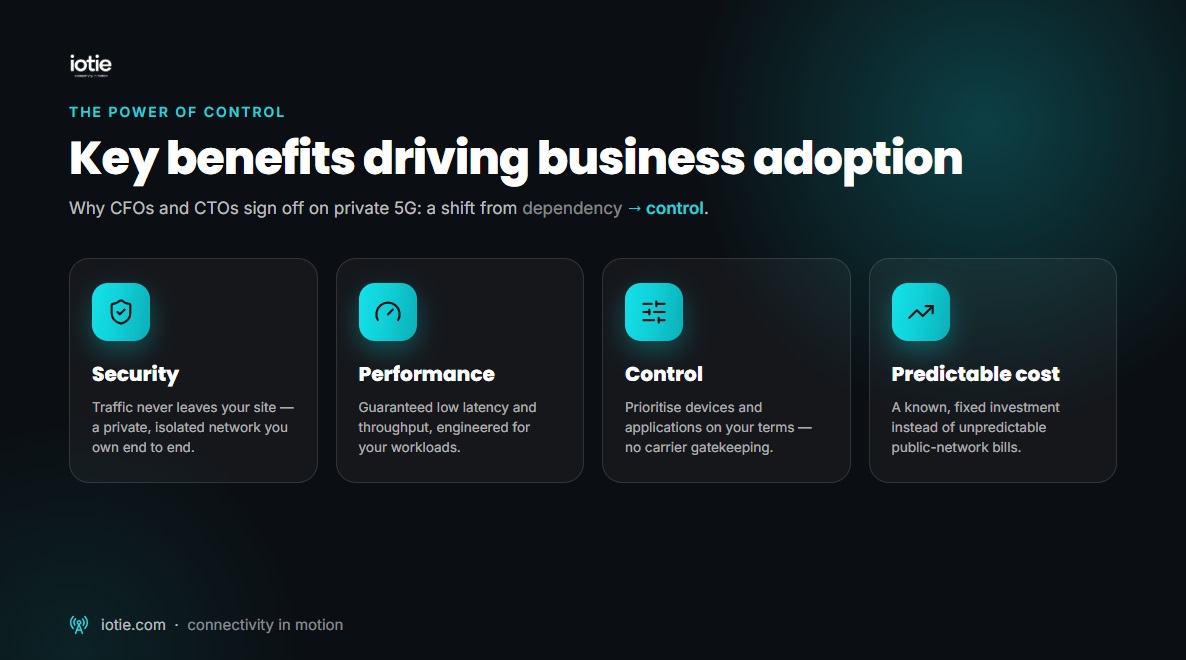
Unparalleled Security and Data Sovereignty
In a public network, you are trusting the carrier’s security protocols. In a private network, you define the encryption, the access rules, and the firewall settings. Because the data stays local, it is significantly harder for outside actors to intercept. For industries like public safety, defense, aerospace, or pharmaceuticals, this data sovereignty is not a luxury—it is a requirement.
Guaranteed Reliability for Mission-Critical Operations
Public networks are prone to outages caused by external factors—a car hitting a pole, a spike in regional traffic, or carrier maintenance. A private 5G network is managed by the organisation. You decide when maintenance happens, you have redundant hardware on-site, and you ensure that your "mission-critical" machines have 99.999% uptime.
Massive Device Density: Connecting Thousands of Sensors
Wi-Fi begins to choke when you try to connect hundreds of devices to a single access point. 5G was built for the Internet of Things (IoT) and the demanding requirements of industrial iot. A private 5G network can support up to a million devices per square kilometer. This allows a factory to put a sensor on every single motor, valve, and belt for predictive maintenance, creating a true "digital twin" of their entire operation.
Customisable Coverage in Hard-to-Reach Places
Carriers build towers where the people are. They don't build them inside deep underground mines, in the middle of vast shipping yards, or inside shielded steel factories. With private 5G, you place the "small cells" exactly where you need them, ensuring there are zero dead zones in the places where your business actually happens.
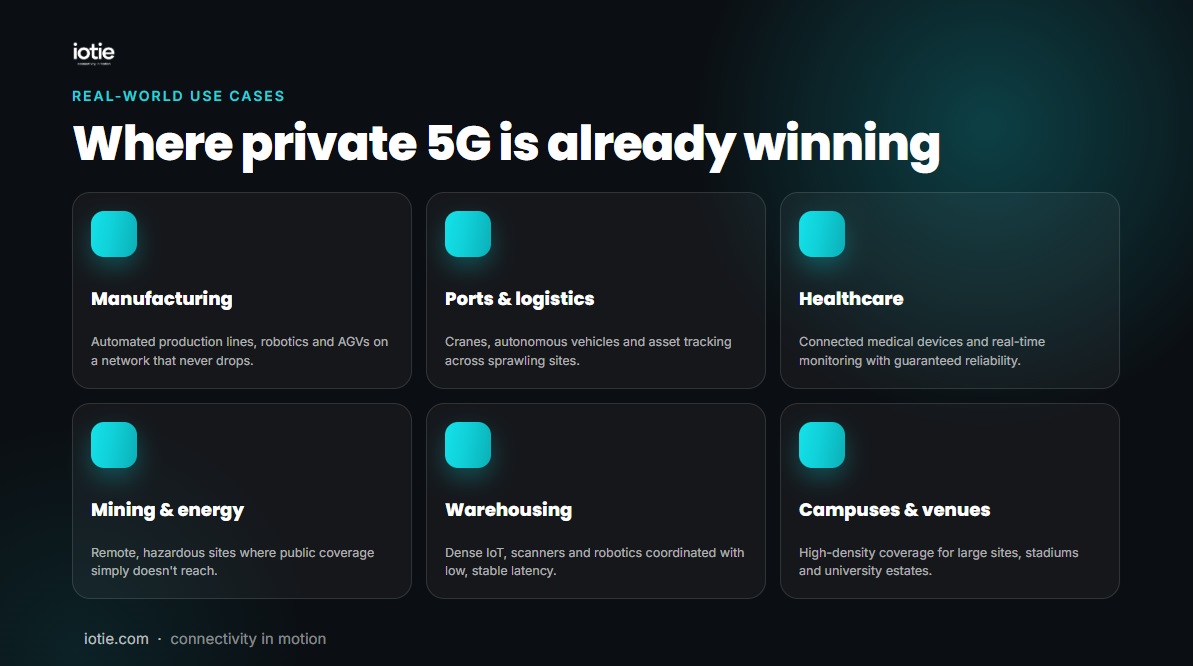
Real-World Use Cases: Where Private 5G is Already Winning
Smart Manufacturing and Industrial Automation
In modern "Light's Out" smart factories, Autonomous Mobile Robots (AMRs) navigate the floor, picking up parts and delivering them to assembly lines. These robots and AGVs require constant, high-speed updates on their environment to avoid collisions. Private 5G provides the seamless handovers and low latency required to keep these fleets moving safely and efficiently.
Logistics and Warehousing: The Autonomous Future
Giant shipping ports, like the Port of Qingdao or the Port of Rotterdam, use private 5G to coordinate autonomous cranes and trucks. These environments are full of giant metal containers that bounce and block Wi-Fi signals. The superior penetration and range of 5G signals allow for total coverage of these massive, metallic landscapes.
Healthcare: High-Stakes Connectivity for Modern Medicine
Hospitals are increasingly using private 5G to manage "smart beds," wearable patient monitors, and even robotic-assisted surgery. By using a private network, the hospital ensures that life-saving medical data is never delayed by a visitor in the waiting room using the guest Wi-Fi to stream a movie.
Energy and Mining: Connectivity in Extreme Environments
Mining operations often happen in remote areas with zero public cell coverage. By deploying a private 5G network, mining companies can operate autonomous drills and haulage trucks from a safe control room miles away, significantly reducing the risk to human workers in dangerous environments.
Public vs. Private 5G: A Side-by-Side Comparison
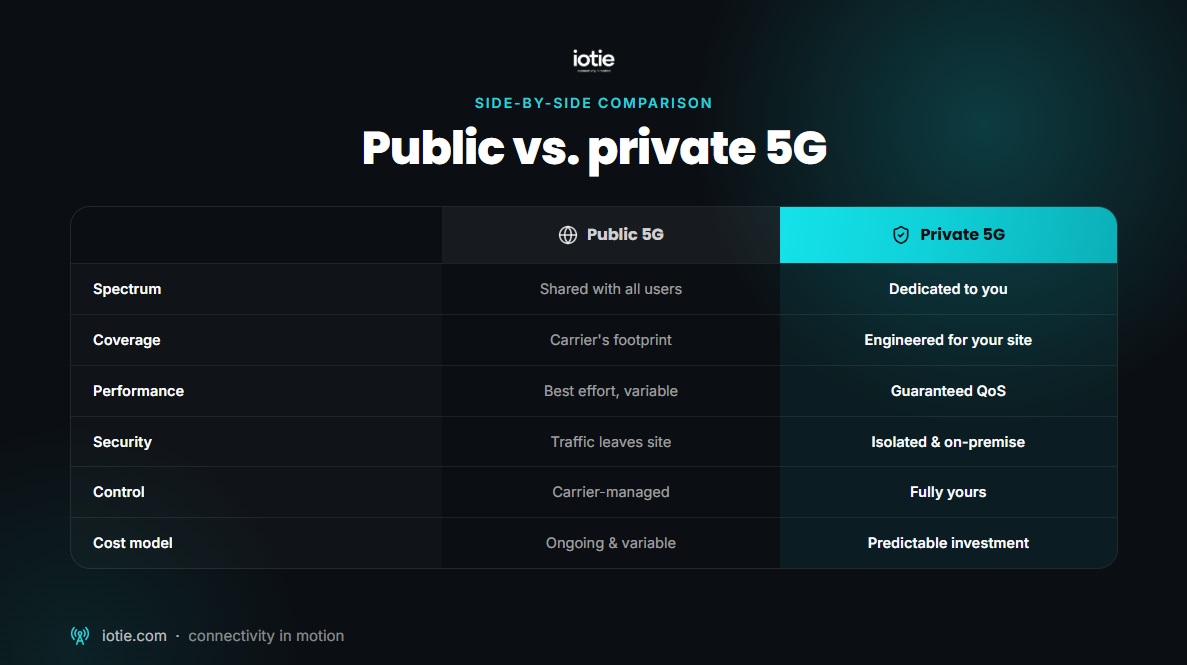
Choosing between these two isn't always an "either/or" proposition, but understanding the trade-offs is vital for any strategic rollout.
Ownership and Management Models
Public 5G is a Service Model. You pay a monthly fee per device, and the carrier handles the tech. Private 5G is an Asset Model. You (or a managed service provider) own the gear and handle the network management. You have total control over the software updates, the coverage map, and the security protocols.
Cost Structures: CapEx vs. OpEx
Public 5G is primarily OpEx (Operating Expenditure)—low upfront cost, but recurring monthly bills that scale with every device you add. Private 5G involves significant CapEx (Capital Expenditure)—you have to buy the hardware and pay for the installation. However, over a 5–10 year period, for an organisation with thousands of devices, the private model often becomes more cost-effective as the "per-device" cost vanishes.
Deployment Speed and Scalability
Public 5G is instant; buy a SIM card, and you're online. Private 5G takes months to plan, license, and install. However, once a private network is in place, scaling "inward" (adding more sensors or robots) is much easier and cheaper than scaling "outward" on a public plan.
Overcoming the Hurdles: Challenges of Implementing Private 5G
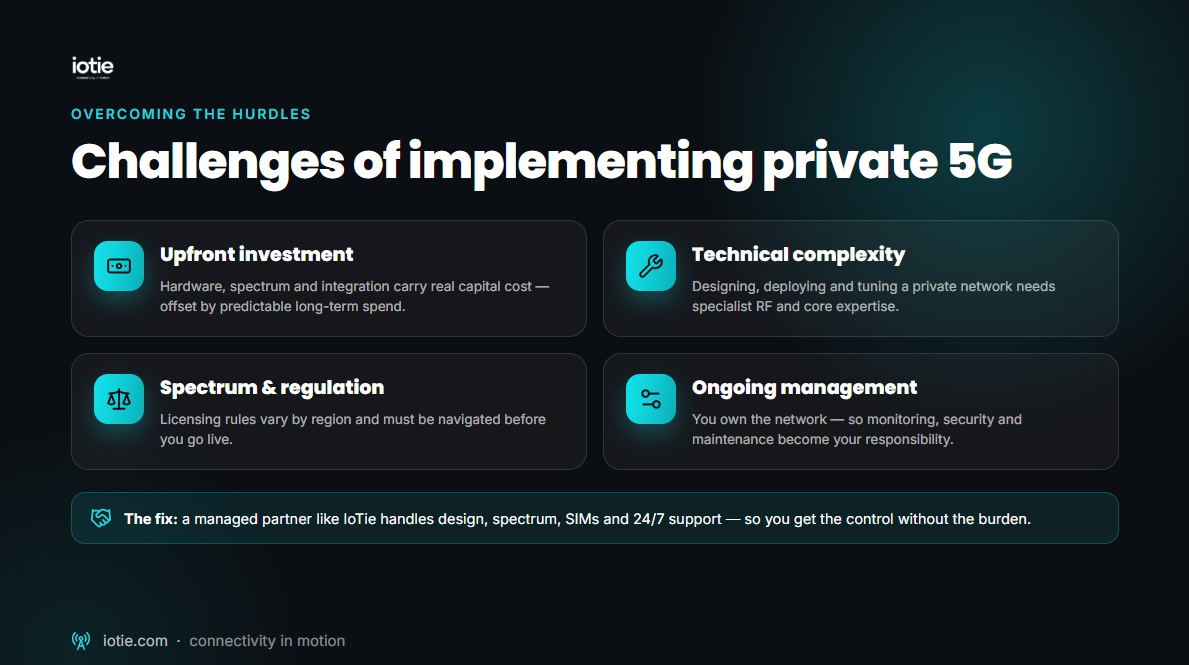
While the benefits are clear, the path to a private network is paved with technical and bureaucratic challenges.
Spectrum Acquisition and Regulatory Compliance
You can't just start broadcasting on any frequency you like; that’s a quick way to get a visit from government regulators. Navigating the legalities of spectrum—whether it’s applying for a local license or using a shared band like CBRS—requires specialised legal and technical knowledge.
The Complexity of Integration with Legacy Systems
Most factories aren't "born digital." They are full of 20-year-old machines that communicate via wires or old proprietary radio signals. Marrying these "legacy" systems with a cutting-edge 5G core requires sophisticated gateways and often custom-coded middleware.
The Talent Gap: Finding the Right Expertise
There is a global shortage of 5G engineers. Building a private network is not something your average IT generalist can do over a weekend. It requires expertise in radio frequency (RF) planning, cellular core architecture, and specialised cybersecurity. Most companies end up partnering with specialised integrators to bridge this gap like IoTie!
Is Your Business Ready? Steps to Evaluating a Private 5G Strategy
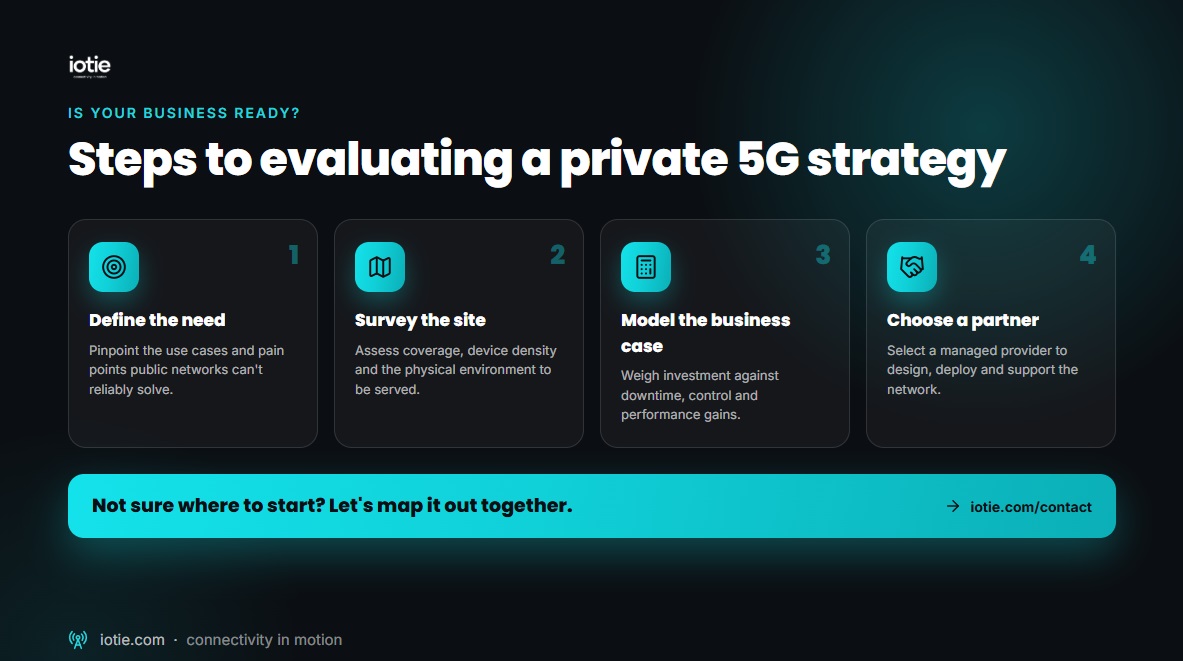
Defining Your High-Value Use Cases
Ask yourself: What is the one thing our current network can't do that is costing us money? Is it the downtime of autonomous vehicles? Is it the lack of data from our assembly line? Private 5G is a precision tool; you need to know exactly what you are trying to "cut" before you pick it up.
Choosing Between Full-Private and Hybrid Models
You don't have to go 100% solo. Many carriers offer "Hybrid" models where they provide a dedicated slice of their public network specifically for your company. This can be a great "middle ground" for companies that want the benefits of 5G without the headache of managing their own core hardware.
The Roadmap to Deployment
Start small. The most successful private 5G rollouts begin with a "Proof of Concept" (PoC) in a single corner of a factory or a single warehouse aisle. Test the latency, measure the reliability, and calculate the ROI before attempting to blanket an entire global enterprise in 5G.
Looking Ahead: The Future of Private Cellular Networks
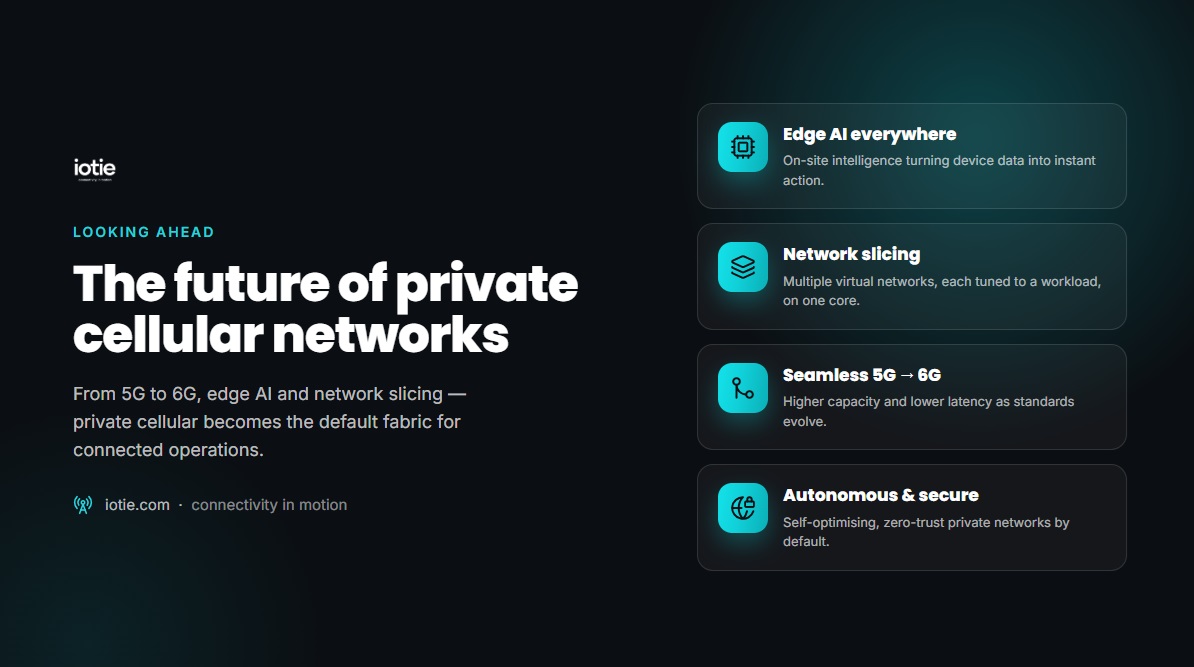
We are moving toward a world of "Hyper-Connectivity." In the next decade, the idea of a factory without its own private cellular network will seem as antiquated as a factory without electricity. As the cost of hardware drops and the ease of spectrum access increases, private 5G will trickle down from massive corporations to mid-sized businesses.
The future isn't just about faster phones; it’s about autonomous systems that can "feel" their environment in real-time, supply chains that manage themselves, and environments that are safer and more efficient because they are blanketed in a reliable, private, and powerful invisible web. The airwaves are being reclaimed—one business at a time.
Looking at Private 5G? Get in touch with IoTie to see how we can help — from site survey and spectrum to SIMs, deployment and 24/7 support.